[Byline Network] Interview: How Trendier AI Is Driving K-Beauty’s Shift to AI-Powered Product Development
![[Byline Network] Interview: How Trendier AI Is Driving K-Beauty’s Shift to AI-Powered Product Development](/content/images/size/w1200/2026/02/-----------------------------------------------------------------.jpg)
This article is originally posted by 성아인 기자 (Sung Ah-In) on Byline Network's December 26, 2025 Article. To read the full feature, please visit the link below:
Have you ever heard a clear answer to the question, “What’s trending these days?”
In trend-sensitive industries like beauty, it’s a question that comes up constantly—yet the process of finding the answer still relies heavily on intuition. By the time trends appear in research reports or news articles, they are often already one step behind.
For brands and manufacturers, this is frustrating. Even after launching a new product, consumer response is only revealed afterward. The same uncertainty applies to where to sell, what price point works, and which messages resonate.
One company is trying to change this structure. Trendier, a beauty-industry–focused data and AI company, aims to transform the speed of decision-making in beauty through specialized data and AI.
Recently, Trendier has positioned itself around the concept of “AI for Beauty Business” and launched its beauty-specific AI service, Trendier AI. Rather than simply stating “what’s trending,” the company’s goal is to answer—through data—what to make, how to sell it, and where to go next. We recently spoke with Kei Chun, CEO of MeasureCommerce, the company behind Trendier.
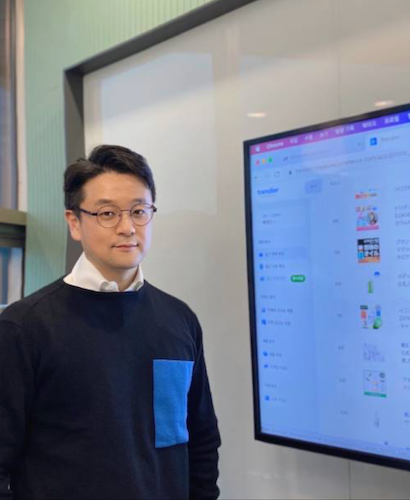
What Is Trendier?
Trendier is a beauty-industry–focused AI platform operated by MeasureCommerce. It provides insights and services based on seller and consumer data from online platforms such as Olive Young, Coupang, and Amazon. According to Chun, the company was founded on the hypothesis that data can serve as a fundamental tool for interpreting markets.
“Trendier helps brands and manufacturers make faster decisions based on beauty-specific data,” he explained.
MeasureCommerce initially operated a data business focused on the Chinese market, but reorganized that business after changes in the external environment following COVID-19. As customers sought data-driven decision-making support, the company expanded its analysis coverage to platforms in Korea, Japan, the U.S., and Europe.
“As we followed the platforms our customers needed, we naturally expanded overseas,” Chun said. “In that process, our business performance and vision actually became clearer.”
He emphasized that a key realization behind Trendier was that countless market signals embedded in public data were being ignored.
“For example, every keyword on a product detail page on Olive Young is the result of intense deliberation. If performance drops, those keywords are changed immediately—it’s a battlefield.
In Japan or Southeast Asia, teams manually track things like daily review counts until late afternoon. We systematize that work and turn it into structured data.”
Connecting Supply and Demand
One of Trendier’s core strengths, Chun noted, is its ability to analyze both supply and demand simultaneously.
“On the supply side, brands emphasize ingredients, efficacy, messaging, bundling, and discounts. Even with the same formulation, performance changes depending on communication and promotion.
On the demand side, we analyze which ingredients and claims consumers respond to, how fast products sell, and how reviews accumulate. Trendier connects both sides.”
He stressed that this approach is fundamentally different from traditional panel-based surveys.
“Even the largest global research firms rely on limited panels. That makes it hard to understand true market dynamics, competition, or what actually drives sales.”
Trendier instead focuses on real market data—product listings, detail pages, and consumer reviews. Its first service, the Trendier Dashboard, used AI to analyze all keywords and reviews displayed on Olive Young product pages.
“Trendier looks at data from both sides and connects it directly to business operations—from market entry decisions and R&D direction to product positioning, promotions, thumbnails, and channel strategy.”
From Dashboard to Library
Trendier later launched the Trendier Library, which identifies micro-trends across the beauty industry. While the dashboard was initially used by around 100 large and mid-sized enterprises, the library expanded the user base to over 3,000 companies.
“SMEs often lack the resources or time to analyze data. So we created a service that delivers 100 micro-trends per month—broken down by price range, category, and ingredients—based on actual growth signals.”
Today, Trendier analyzes over 1.1 billion product, review, and keyword data points across more than 30 global platforms.
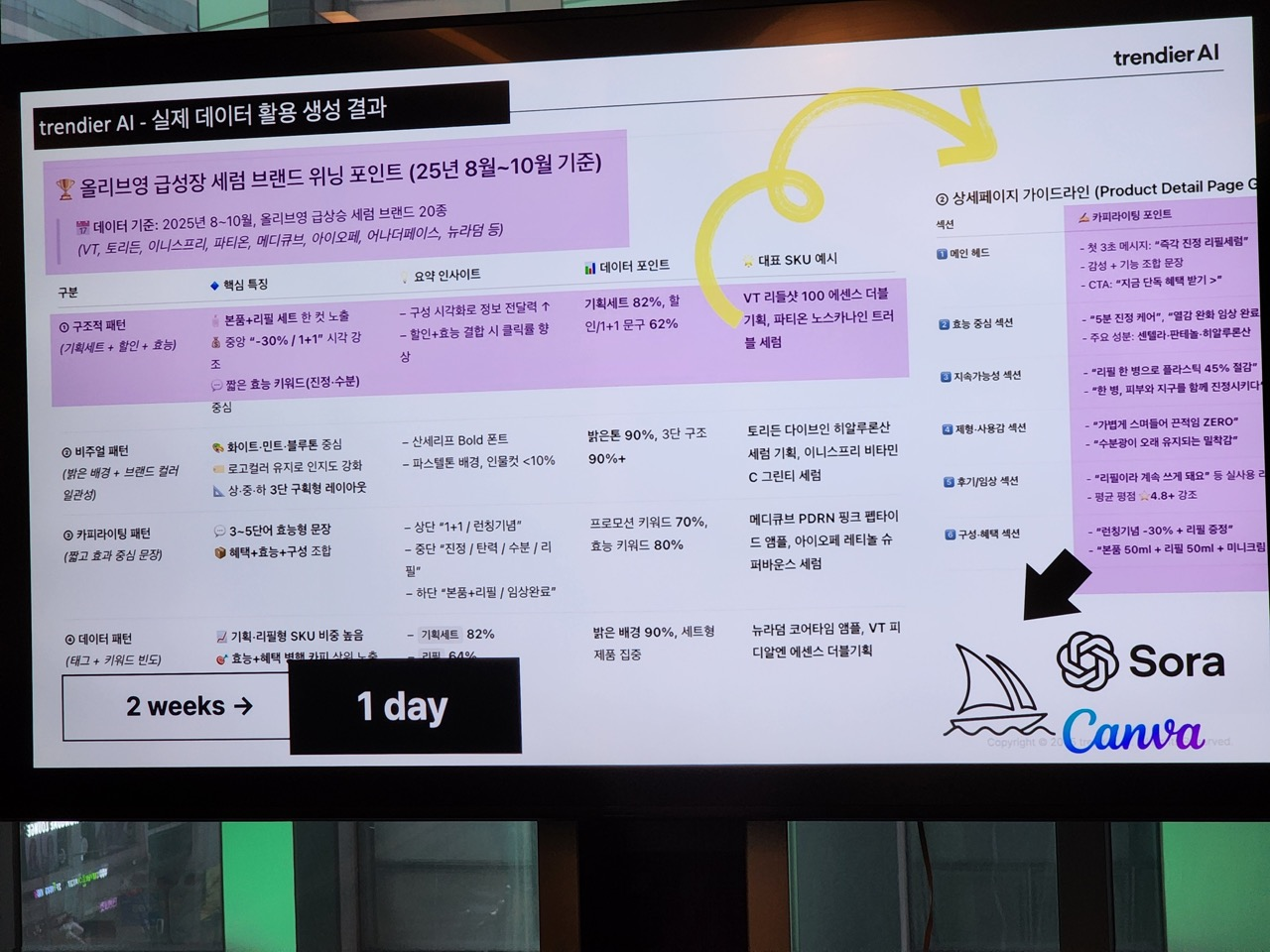
“What Took a Month Now Takes 10 Minutes”
In 2025, Trendier’s main focus became AI. The company now fully embraces the identity “AI for Beauty Business.”
A representative example is Trendier AI, launched in beta last November as an in-app ChatGPT service. Built entirely on Trendier’s proprietary data—without external web crawling—it provides answers with clear sources, figures, timeframes, and platforms.
Chun explained that beauty-industry AI is difficult to build with general-purpose LLMs alone.
“Like law or finance, beauty requires deep domain knowledge. Generic AI often lacks evidence or fails on detailed questions like which ingredient combinations actually sell.”
Trendier AI addresses this by cross-analyzing ingredient, efficacy, and review data from existing market products—allowing brands to ask questions such as ‘Will this ingredient combination actually work in the market?’ and receive data-backed answers.
Speed is a major differentiator.
“If concept development used to take a month, Trendier AI can reduce that to a tenth of the time,” Chun said.
During a live demo, Chun showed how AI could identify signals where review growth outpaces product supply—indicating unmet demand.
“What used to take a month of jumping between websites can now be completed in about 10 minutes through templates.”
Designed for Real-World Operations
Trendier actively educates customers on how to best use Trendier AI, including hosting AI bootcamps for over 100 clients. The company customizes guidance based on whether the user is a raw material supplier, manufacturer, brand, or platform.
“For example, lip care is currently a favorable category for Amazon entry. Supply grew 9%, but reviews increased 182%, with Laneige performing particularly well.
Indie brands can assess entry feasibility, while ingredient suppliers can identify new sales opportunities.”
Trendier plans to make Trendier AI publicly available later this year or early next year. While it initially launched via the ChatGPT Store for cost efficiency, the company is also preparing standalone deployments to support deeper customization.
Looking Ahead
Trendier has already passed its breakeven point and is considering fundraising to accelerate growth. While it currently serves over 3,000 teams through a subscription model, the company plans to expand its services with Trendier AI at the center.
“Many teams talk about AI, but few have built truly vertical, industry-specific AI products that perform in global markets,” Chun said.
Trendier AI has already led beauty-specific AI sessions at Cosmoprof Hong Kong, and was selected for the NRF 2026 Innovators Showcase in New York—the first Korean company to do so.
When asked about how his vision has changed over the past two years, Chun replied:
“Two years ago, I said I wanted to build a co-founder AI. That hasn’t changed. As automation increases, what matters most is building a structure where humans and AI make critical decisions together. That’s why we’ve focused on organizing data from the very beginning.”

![[코스인코리아닷컴] 트렌디어AI, ‘트렌드 검증 AI’ 공개... “한 달 걸리던 시장 검증, 하루로 압축”](/content/images/size/w600/2026/03/66634_3262917_1772532170055817964.jpg)